Test what survives a game’s shutdown before funding it
Publishers can find out what buyers will lose when a game’s servers close while the team still has time to change the design.
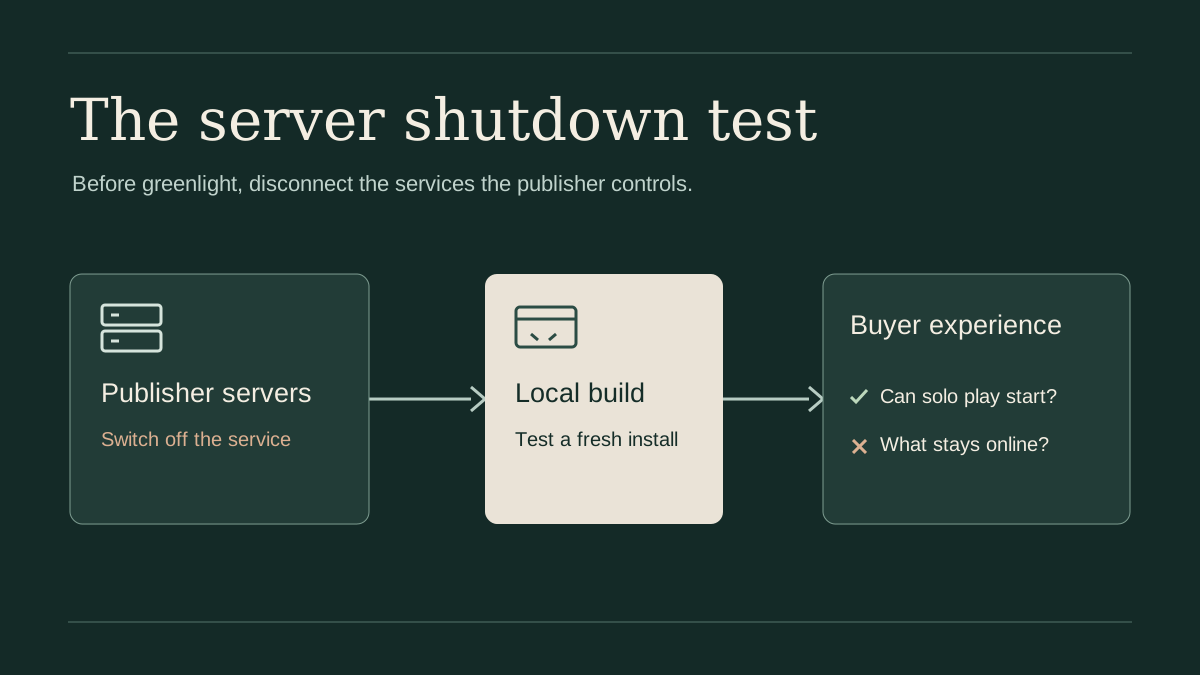
The shutdown test
Before a publisher approves a game that needs its servers to run, it should ask the production team to demonstrate what a paying customer will still be able to do once those servers are gone. The answer can be modest: a solo campaign, local races or a licensed handover to another operator. But the test belongs at the point when a publisher can still change the architecture and negotiate the rights. At shutdown, the engineers who know the system may have moved on, the agreements may be expiring and the game may already have lost its claim on the budget.
In June, the European Commission responded to the Stop Destroying Videogames citizens’ initiative. It said it was not proposing the requested legal obligation to leave games playable after commercial support ends and set out plans to begin talks with industry and consumers by the end of 2026 about an industry code. That gives publishers a chance to propose a standard they can actually test. A shutdown notice tells the buyer when something stops working. A working build reveals how much of the purchase depended on the company continuing to operate it. [1]
Ubisoft’s racing games illustrate the difference. The company delisted the original The Crew in December 2023 and shut down its servers on March 31, 2024. It had warned that the game would become inaccessible and cited server infrastructure and licensing constraints. In October 2025, Ubisoft released a different arrangement for The Crew 2. Its new offline mode kept solo play available without a connection, with an option for players to copy their online progression to a local save. Multiplayer and player-created races and liveries stayed behind. These were two different products, so the comparison gives no basis for assuming that the first could have been retrofitted on the same terms. [2] [3] [4]
The sequel makes the design choice unusually visible. A racing game can preserve the act of driving and still lose the experience of competing against a community. A local save can carry a player’s collection while omitting things that existed only on the service. The customer needs to know which promise was made. For a publisher, the question is whether the functions it markets as central can be separated from those that genuinely require the live service. That should be a production decision with an owner and a budget.
What a publisher should fund
Consider a hypothetical studio pitching a cooperative adventure. It plans to use a single login for solo play, matchmaking and store purchases. That is convenient while the studio operates all three. It also means that abandoning the store could end up taking the single-player campaign with it. At greenlight, the publisher can ask for a small build that starts without the login service and reloads a saved game. The prototype may expose difficult dependencies early enough to deal with them. If the studio can show the campaign works, the publisher can decide whether the ongoing cost of testing that mode is justified by what customers will receive.
Code is only half the exercise. A separately licensed soundtrack, a middleware agreement or a storefront’s distribution requirements can determine what the company can deliver even when the build runs. The release producer needs a list of permissions that must survive commercial support and a person responsible for securing them. The same test should cover how an existing buyer gets the final build and what happens after a fresh install. An offline mode already on a player’s machine and a copy that can still be installed later are different promises.
There is a good objection to making an offline build the industry default. A persistent world is made by the people in it. Copying environments and quests to a local device might preserve a tour of that world while stripping out the activity that made it worth playing. And handing server software to a community could mean disclosing code the studio has no right to distribute or passing security and moderation obligations to people who cannot take them on. The Commission’s communication identifies legal and technical constraints on keeping games functional. A blanket obligation to deliver the same outcome across genres would ignore those constraints. [1]
A credible industry standard could instead require a publisher to describe the outcome it can deliver and test it against the game it advertises. For an adventure with a substantial single-player campaign, a publisher that can demonstrate an affordable standalone build has a strong case for maintaining it. For a service whose core feature is a shared world, studio leaders might test whether an independent operator can legally run a restricted instance. If a representative test shows a fallback consumes substantial resources while preserving little of what people bought, the case for paying for that fallback weakens. The failure still matters. It should shape the offer customers receive at launch.
Where the market stops
A publisher’s incentives change once sales dry up. Keeping an older build usable can cost money after it has stopped earning any, while the value of being able to study or revisit it accrues to players, museums and researchers. A Video Game History Foundation and Software Preservation Network study found that 13 percent of the classic US releases in its sample of 1,500 were commercially available as of April 2023. It measured availability in the reissue market, so it cannot show how many games were completely lost or how many went offline when servers closed. It does give an indication of how rarely commercial distribution alone kept those sampled works in circulation. [5]
That gap changes what a publisher should discuss with an archive. The materials needed to study a multiplayer game may include a documented build and records of how people played it, even if no institution can recreate its population. A permitted deposit with access terms agreed in advance can give researchers something they can work with. A deposit does little for a customer who paid for a campaign and can no longer load it. Each outcome deserves its own acceptance test, and neither should assume rights that the publisher has yet to secure.
The next useful conversation about a code should begin with a working demonstration. Ask a studio to disconnect the services it controls, start from a supported installation and show what the buyer can still play. Ask where a usable copy will come from and who is allowed to distribute it. Put those answers before the executive who can still change the budget, and before the customer who can still decide whether to buy. Once the servers go dark, a promise to consider preservation has already lost most of its value.
Sources & public records
- European Commission · Communication on the Stop Destroying Videogames citizens’ initiative · 2026-06-16
- Ubisoft · An Update on The Crew · 2023-12-14
- Ubisoft Help · Decommissioning of online services for older legacy Ubisoft games
- Ubisoft · The Crew 2 Hybrid Mode is now available · 2025-10-16
- Video Game History Foundation and Software Preservation Network · Survey of the Video Game Reissue Market in the United States, version 1.1 · 2023-07-10
Related analysis