When does a platform hit justify permanent hires?
A studio can see who found its game through recommendations. The hiring decision depends on whether the team can repeat the result.
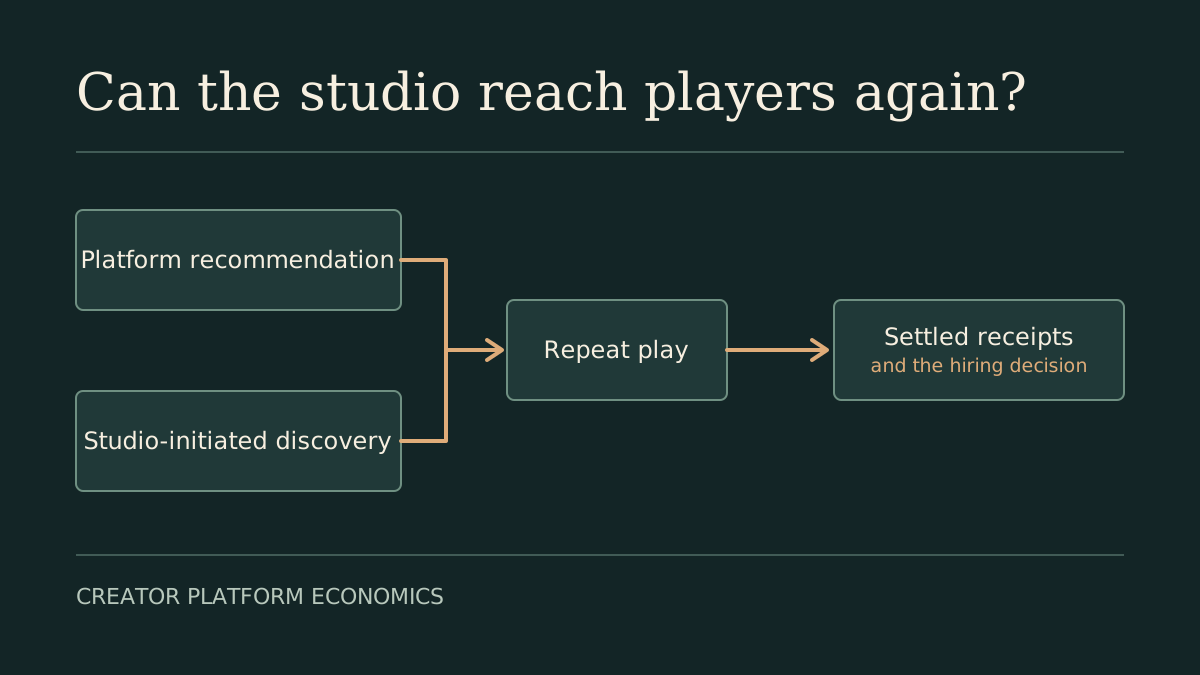
What the platform supplies
A small game studio can know which thumbnail brought a player to its island, how long the player stayed and whether they returned. It may know much less about whether that player would follow the team to another game. Those are different questions, and the second matters when the studio hires permanent staff against a successful launch. Before approving recurring costs, studio leaders should separate demand the team can reach again from demand it can reach only through the platform’s recommendations. Both can be worth building for. They support different commitments.
The distinction came into view outside games this week. Motom announced a tool that moves creator campaigns into storefronts operated on a brand or retailer’s own site, with campaign management and payment handled inside that program. A retailer can use social platforms for discovery while keeping the transaction and its first-party sales data within its own operation. The announcement establishes what the product offers. It gives little basis for judging whether a creator can take useful campaign records to another partner or maintain the same earnings after a campaign ends. [1]
A game studio faces a version of the same problem. Distribution inside a large game can spare a team the expense of building a separate destination and persuading players to install it. Players can try a new experience using an account they already have, and they can bring friends along. Those advantages are real even if the audience never follows the studio anywhere else. The mistake is to read a well-performing dashboard as evidence that the team could reach the same audience under different distribution terms.
Follow a player from discovery to payout
Roblox’s creator documentation describes how its Home recommendations use signals including qualified play, returning play and intentional play with friends. Its acquisition dashboard also distinguishes recommendation traffic from other sources and lets teams track acquisition links. If an update draws more people from Home, the studio can examine whether those players actually play and return. The result can justify more investment in the experience. A separate test is whether the team can bring players back through a permitted channel it can activate itself. [2] [3]
Fortnite makes the connection between distribution and payment particularly clear. Epic says its engagement pool receives 40% of eligible net revenue from the Fortnite Item Shop and related real-money purchases. Eligible islands, including Epic’s, share the pool under its formula. For new or lapsed players, Epic describes different attribution depending on how they find their first island. Qualifying search or direct-link arrivals can be attributed to that island, while contributions for players arriving through Discover can be divided by first-day playtime across the islands they visit. Epic documents limits on link attribution by device and region. A studio modeling an island’s earnings therefore has to ask where the player came from as well as how much time they spent playing. [4]
Consider a hypothetical team whose new island is recommended widely after a content update. Its operating plan now includes more community support and a larger art team. Even if the update explains some of the growth, the team still needs to know whether it can reach players again when the recommendation surge ends. If a subsequent launch depends on a fresh placement, the original audience is useful evidence about the design. Its value as a repeatable source of distribution remains uncertain. The distinction affects payroll before it ever shows up in a valuation.
Simply putting the same experience on a second platform may do little to resolve the uncertainty. Players can value the original platform’s social features, a shared inventory or the fact that their friends already play there. The studio could carry over a visual style, a production pipeline and the judgment of its designers and still have to earn its audience afresh. A cross-platform pilot is worth running when it tests a particular assumption, such as whether players seek out the format independently. Maintaining a second version indefinitely is a much more expensive experiment.
What justifies a permanent team?
There is a serious case for concentrating on one platform. A specialist studio can learn the tools more deeply, ship faster and make better games for the community it understands. A dependable distribution partner can be more valuable than several channels that receive too little attention to work. For some teams, the best evidence for hiring is a record of successive releases that find paying or returning players under ordinary discovery conditions. If those results persist through different placements and updates, and settlement records show that receipts consistently cover the proposed costs, the case for expanding on the platform improves.
The next budget review should ask for acquisition and payment evidence from the same release. A studio can compare cohorts from ordinary recommendations, direct links and other permitted sources, then look at repeat play, settled receipts and support costs by cohort where the available data allows. A test should span a normal release cycle and include a period after any special featuring has ended. If a creator dashboard cannot connect a cohort to settled cash, management can record the gap and give that assumption less weight in the hiring decision. The comparison should use aggregate or permissioned data. A better forecast does not require collecting player identities or soliciting contact details from children.
The evidence matters to workers and players as well as to investors. Developers who join after a successful launch bear some of the cost if a studio mistakes a burst of distribution for recurring demand and then has to cut its team. Players can lose a community or an experience they expected to keep using if the studio can no longer support it. A platform’s ability to put a good game in front of new audiences can benefit both groups. The relevant question is whether the studio has the receipts and operating capacity to sustain the service through the next release.
Give a successful platform launch enough budget to test whether the result can be repeated. When settled earnings cover the ongoing team through ordinary release cycles, hiring into that platform can be a sensible specialization. When the evidence comes mainly from an unusual period of exposure, fund the next release in stages and tie the permanent hires to what the team learns. A studio can decide to depend on a distributor. It should know which part of the payroll depends on that distributor making the same decision again.
Sources & public records
- Motom via PR Newswire · Motom announces Opportunities · 2026-11-12
- Roblox Creator Hub · Discovery
- Roblox Creator Hub · Acquisition analytics
- Epic Developer Community · Engagement payout in Fortnite Creative
Related analysis