Who can stop an AI-localized release?
A regional editor who hears a mistake needs the authority to hold the asset and a producer who can get it corrected.
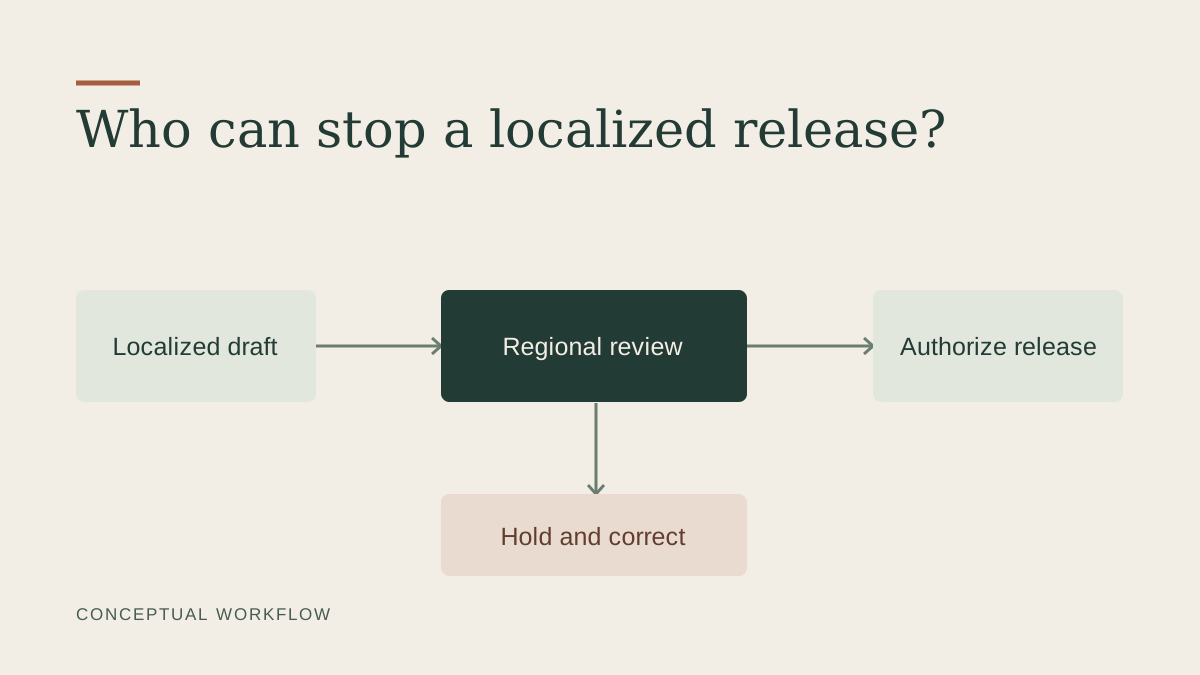
Who gets to stop a release?
A line in a dubbed drama can be accurate on paper and wrong in the scene. A character addressing an older relative may sound deferential in one version and mocking in another. The sentence still makes sense. The relationship changes. If a localization system has already marked the line as approved, the commercial question is whether the editor who hears the difference can stop it from shipping. Studios should buy AI localization with an enforceable right to pause and correct a release, reserved for decisions that are costly to reverse or that change the work audiences receive.
RWS’s November launch of Weava puts that choice in view. The company describes an enterprise workflow that pairs machine translation with simulated audience profiles, flags issues and can make corrections against configurable thresholds. Human specialists are available when extra judgment is needed. The release describes the workflow and offers no independent measure of how often real audiences agree with its judgments. For a buyer, the unresolved question is how a disagreement moves from a vendor dashboard to someone with authority over the release. [1]
The workflow is easiest to assess when a mistake can be fixed cheaply. A mislabeled menu entry can often be replaced in a later update. A line that changes the emotional meaning of a scene may require a new recording, another mix, another approval and replacement of copies already sent to distribution partners. In a hypothetical game launch, a studio could update the subtitle overnight and still have the mistaken performance in a trailer and several builds. Procurement ought to care about which errors travel beyond the first file and who can recall the versions downstream.
Permission and judgment belong to different people
A study by William Brannon, Yogesh Virkar and Brian Thompson examined roughly 320 hours of professionally produced material across 54 titles. The researchers found evidence that dubbing choices carry features of the original performance such as emphasis and emotion, and argued that vocal naturalness and translation quality deserve more weight than some automatic systems give them. Their corpus describes professional practice. It cannot tell a distributor how audiences will respond to a particular synthetic dub. It does give the buyer a reason to sample complete scenes rather than ask a reviewer to clear lines in isolation. [2]
The 2026 SAG-AFTRA theatrical and television memorandum identifies a separate decision. Its foreign-language dubbing provision applies the specified consent requirements to digital replicas used to adjust a performer’s voice for qualifying productions where principal photography and the performer’s contract both meet the July 1, 2027 date condition. The provision excludes the referenced compensation requirements for that use. Its scope is specific to the agreement and the circumstances it describes. A studio planning a dub needs to establish whose permission it requires before authorizing the vendor to generate the track. [3]
A performer’s permission to use a replica and a local director’s approval of the resulting performance address different risks. The performer can authorize a use that the director subsequently judges unsuitable. The director can also approve a performance whose underlying permissions the producer has yet to confirm. The final approval record should let production staff resolve both questions. If the voice must be recast, the agreement with the vendor should already say who supplies the replacement and who pays for the resulting work.
That allocation affects translators and dubbing directors as well as performers. If a studio pays a supplier per accepted minute and gives its own local team no budget for investigating disputed scenes, the person who sees the problem has to argue for delay against a delivery target. A practical arrangement gives a named local reviewer authority to hold a particular asset, requires a reason tied to that scene and assigns a producer to resolve the dispute within an agreed period. The hold can be narrow enough to let unrelated languages and episodes ship.
Buy the ability to correct a mistake
The strongest objection is access. A smaller distributor may have enough demand to justify translated subtitles for a title and too little expected revenue to commission a full dub. A blanket requirement to review every asset at the same level would put some languages beyond its budget. Those audiences have something to lose from an expensive approval process. The case for review is strongest when a decision materially changes the performance, uses a likeness or voice that requires permission, or creates a version whose distribution makes correction slow. Routine assets can move through sampled checks, with authority to widen the review when the sample reveals a recurring error.
A pilot can make that tradeoff visible. Give regional reviewers comparable scenes from the current workflow and the proposed one, without telling them which tool was used. Ask them to flag changes in character relationships, emphasis and meaning that would warrant a rerecording, then record how much work each accepted scene takes through to delivery. Test a deliberate correction during the pilot as well. The producer should be able to locate all affected versions, notify distributors and replace the asset. If a supplier’s faster first pass still leaves a producer chasing versions across several channels, the quote understates the cost of releasing the work.
The review should also give audience feedback a destination. A viewer who reports a misleading translation should be able to identify the language track, scene and version without learning which vendor produced it. A local editor needs the corresponding source material and a way to see whether the same choice appears elsewhere. Repeated complaints about a single expression may justify a style change across the series. Silence after release is weak evidence by itself, especially in a market where viewers have little reason to expect a report will reach anyone who can act.
A lighter approval process can earn its place. If blinded regional reviewers consistently find comparable performance and meaning, accepted scenes cost less after rework, and the producer can demonstrate a timely replacement across distribution channels, broader sampling becomes reasonable. A buyer could then expand automation first in languages and asset types where that evidence holds. Procurement should ask for a correction demonstration before signing the volume deal. The practical value of a release approval is the authority to change what ships when the person closest to the audience hears something everyone else missed.
Sources & public records
- RWS via PR Newswire · RWS launch announcement for Weava · 2026-11-10
- Transactions of the Association for Computational Linguistics · Dubbing in Practice: A Large Scale Study of Human Localization With Insights for Automatic Dubbing
- SAG-AFTRA and AMPTP · 2026 Theatrical and Television Memorandum of Agreement · 2026-05-27
Related analysis