The real test of games funding comes on the next project
Public support can help a studio finish a game. A renewal decision should ask what the studio can do independently on the next one.
What survives the grant
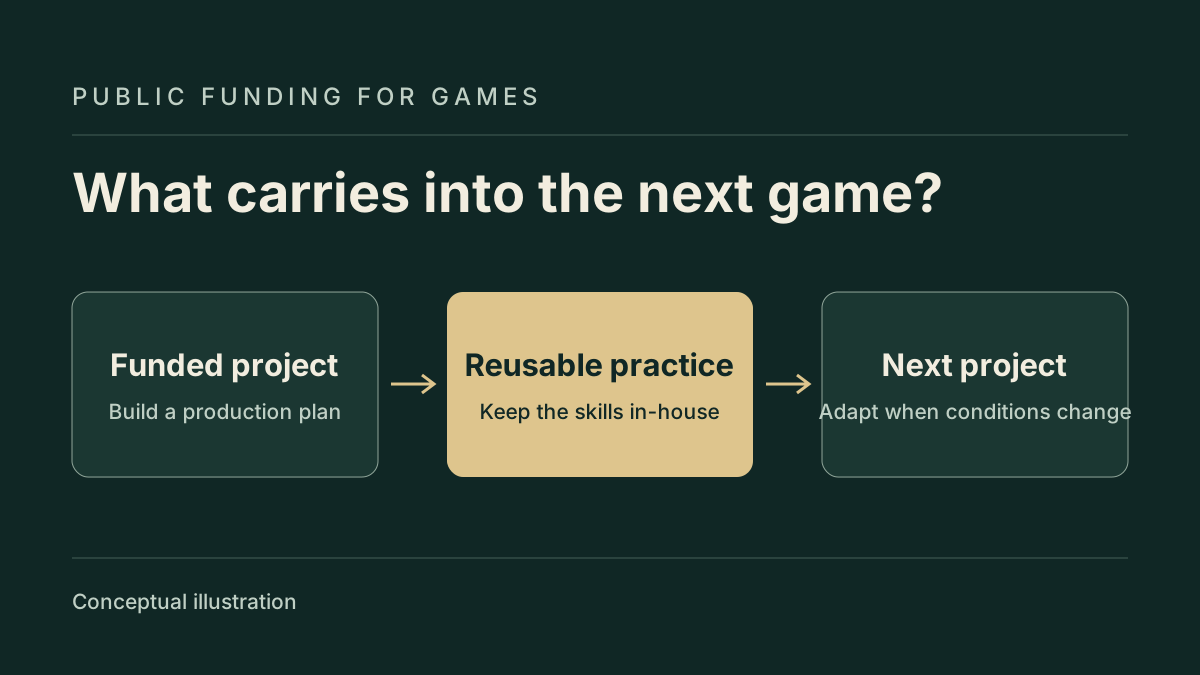
A studio can finish a publicly funded prototype, pay its team and still face the same problem when the next project begins. The founder is again the only person who can price a milestone, the production plan depends on a contractor who has left, or the team has no clear basis for deciding what rights to offer a publisher. The prototype may be a genuine achievement. A programme intended to build a stronger games industry should earn renewal by showing that studios can use what they acquired on another project after support ends.
The British Film Institute’s business-development call gives funders a chance to set that test in advance. The BFI is offering one delivery award of up to £1 million for training aimed at independent UK games businesses. The recipient is a programme provider. The guidelines exclude grants or loans to participating companies and game development costs. They require an independent evaluator to examine delivery and impact during the funded period. That distinction matters because a course can meet its delivery targets long before a studio makes the decision the course was meant to improve. [1]
Consider a hypothetical studio that takes a course in financial planning while preparing a publisher pitch. The immediate output is a more legible budget. The business capability is the ability to revise that budget when a partner wants a different release window or a platform changes the scope of a port. It has transferred when someone on the team can explain what work has moved, how that changes the cash needed before the next payment, and what can be cut without damaging the product. A tidy spreadsheet that only a visiting adviser can update gives the studio much less room to negotiate.
This has a consequence for employees and contractors. A credible production budget can give a team time to address a shortfall before it becomes a rush to sign a poor deal or let people go. The worker outcome is the quality and continuity of paid work, including whether people can carry a credit or a new responsibility into another job. The studio outcome is more control over the next decision. They can diverge. A firm may become better at scheduling by using shorter contracts, while a team that closes may have helped its members build careers elsewhere. A funding review should preserve both facts.
What the older fund measured
The UK Games Fund offers a useful comparison because its evaluators asked about work that could outlast a title. In its 2025 report for the government, Alma Economics compared successful and unsuccessful applicants using survey data. Its binary difference-in-differences specification associated funding with an 11-percentage-point increase in the probability of developing reusable code or assets after one year, based on 139 responses used in that specification. The estimate was statistically significant at the 10 percent level. The survey measured whether teams generated reusable material. Actual reuse on a subsequent production would be a separate observation. [2]
The comparison is more informative than a gallery of successful alumni. It still depends on how similar the groups would have been without funding and on who responded. A promising team may be more likely to win support and more likely to build a useful production tool. Teams that cease trading may be harder to reach. The result justifies collecting better evidence of transfer. A renewal decision would benefit from knowing whether a producer actually reused a tool, whether the team had the rights and documentation to do so, and whether the practice survived the departure of the person who built it. [2]
The government's 2026 follow-up also shows how easily measures can get ahead of the underlying work. Content Fund beneficiaries described using support to improve a prototype or secure private investment. The evaluators’ cost-benefit analysis had to use revenue projections in cases where titles lacked an established sales record, and the report recommends revisiting the estimate when more actual revenue is available. An introduction to a publisher, a signed agreement and cash received are successive events. They tell an evaluator different things about whether the team could finance another production. [3]
The strongest objection is that waiting for another project can take too long. A first-time studio may spend the entire award period learning how to ship one title. It may discover that the project should stop, which can be a better commercial decision than finishing it. Evaluation can also become a barrier if the easiest way to meet the requirements is to recruit established teams that already know how to document their work. A fund should be able to recognize early progress, especially when workers take skills into another local studio and the original firm never makes a second game.
What a funder should ask before renewal
The practical answer is to set the evidence at the stage where the team can reasonably supply it. At entry, record a live decision the studio struggles with and ask for the material it currently uses. At the end, look for a change in the quality of that decision. A later sample can check whether the work was adapted when the facts changed. A first-time team could demonstrate that it revised a production plan when a key assumption failed. A more established team could show how a different producer used the same process on a different title. Confidential records can be reviewed by the evaluator with aggregate results reported to the funder.
Where the design permits it, invite comparable applicants who did not receive support to take part in the follow-up. A staggered intake can provide a second comparison when everyone will eventually get access. Record who declined to participate and who became unreachable, and keep closures visible. A funder can pay for a small sample of detailed checks instead of asking every founder to complete a large monitoring return. If completion reliably predicts later use in comparable studios, lighter follow-up makes sense. If the association disappears once teams outside the programme are included, the provider has learned something worth acting on before the next intake.
The spending choice comes down to the constraint. When a team can already cost, staff and manage a project but cannot afford a milestone that investors need to see, production finance may be the better use of public money. When repeated delays stem from the way a studio budgets or organizes work, another production award may buy time without fixing the problem. A renewal panel should be able to point to a consequential decision a studio can now make with its own people and evidence. If it cannot, it has a reason to redesign the next round before paying to expand it.
Sources & public records
- British Film Institute · Guidelines for delivering business development training for independent games companies
- Department for Culture, Media and Sport / Alma Economics · Evaluation of the UK Games Fund, impact findings and Table 9 · 2025-07-18
- Department for Culture, Media and Sport / Alma Economics · Evaluation of the UK Games Fund, final follow-up report · 2026-07-16
Related analysis