Game studios need an apprenticeship strategy for AI
A faster first pass can take away an early opportunity to learn. Producers should measure whether junior developers can still take ownership of the next assignment.
The work behind the work
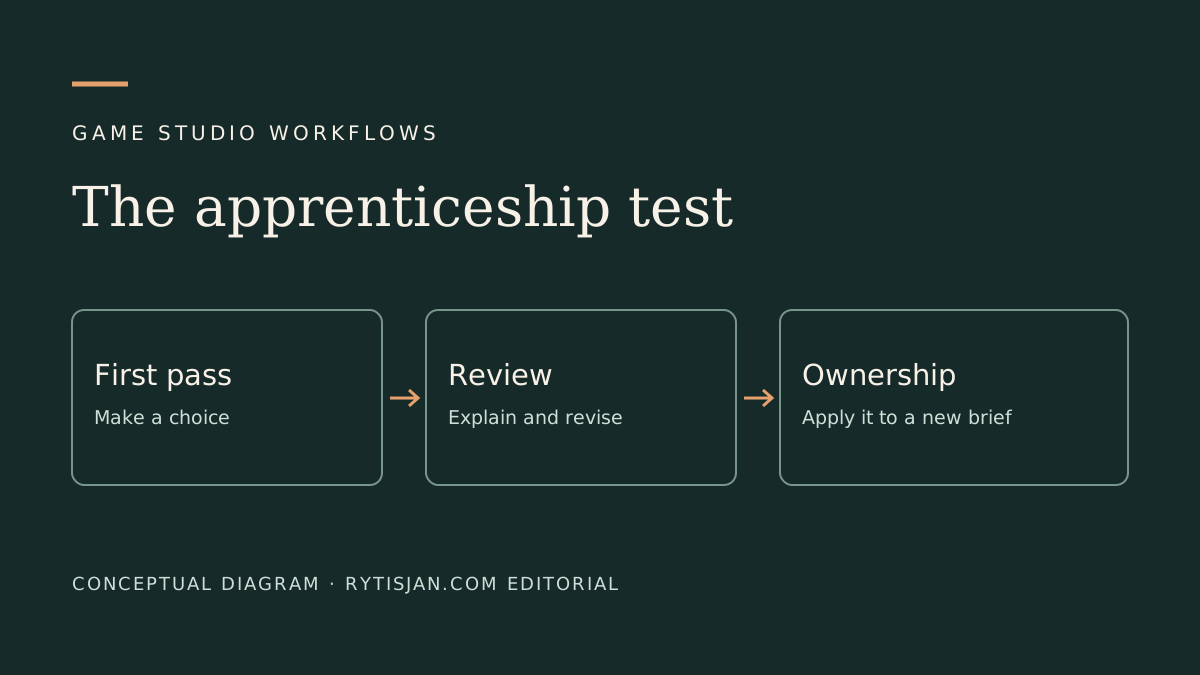
A rough environment sketch used to give an art lead two things to review. One was the world on the page. The other was whether a junior artist could take a vague brief, make a choice and explain it. An AI tool can produce a more polished first pass. The second kind of evidence can get harder to see. A game studio should count the saving from automating first-pass work only after it can show that the redesigned workflow still turns early-career staff into people who can make and defend production decisions.
Adobe and Disney’s November alliance makes that distinction concrete. It extends a relationship whose June announcement described using a custom model to turn hand-drawn sketches into rendered concept art for Imagineering. The newer announcement puts model development alongside collaboration with the studio innovation lab and ESPN. Theme park design differs from game production, but both rely on a handoff from exploratory work to people who must make it function within real constraints. The releases describe tools and applications. They offer no measured comparison of how workers learn in the old and new workflows. [1] [2]
In GDC’s 2026 survey, 30 percent of respondents working at game studios reported using generative AI in their jobs. The organizer separately surveyed a smaller group of students and found substantial concern about entering the industry. Those answers document respondents’ experience and sentiment. They cannot tell a board how many entry-level roles exist, what caused a given layoff or whether a new workflow teaches better than its predecessor. That last question belongs in the studio’s own production review. [3]
Consider a hypothetical encounter in a game. A junior designer assembles a crude first version and watches a playtester miss the intended route. In review, the lead asks the designer to explain which cue failed and test a different placement. The value of the assignment is the sequence from making a choice to seeing someone respond to it. If software assembles the first version and a senior designer fixes the encounter before the junior sees the playtest, the studio may deliver a good level while teaching the person assigned to it very little.
Where the saving goes
A producer can record fewer hours on a first pass immediately. The time a lead spends rejecting variations, checking technical constraints or redoing work may sit in a different budget. The loss of a training opportunity may sit in no budget at all. It becomes visible when a studio needs someone to own a feature and discovers its candidates have spent a year preparing material for other people’s decisions. Hiring from outside can solve an individual vacancy, but its price and availability belong in the comparison with developing the skill internally.
A randomized METR study of experienced open-source developers using early-2025 tools offers a reason to count actual elapsed work. The developers thought assistance had saved them time, yet the study found that the tasks assigned to allow AI took longer in that setting. A small study of experienced contributors on familiar repositories cannot establish what current tools do for junior game designers. It does show why a studio should check its own production records before treating participants’ estimates as savings. [4]
The objection is that an apprenticeship built around low-level tasks can be a poor apprenticeship. Repeatedly resizing textures or rewriting boilerplate may earn a credit without exposing anyone to a meaningful decision. A junior who uses an approved tool to compare lighting plans can have a better discussion with an art director than one who spends the whole afternoon preparing a single version. If the extra options come with a requirement to choose, explain and revise, the technology can give the junior more practice than the old assignment did.
There is also a genuine staffing tradeoff. A small studio with a ship date and an overstretched lead may reasonably purchase a tool or contract for a narrow capability. It may have neither the resources nor a steady project pipeline to run a formal apprenticeship. That favors protecting a few assignments that build transferable judgment. A producer can drop repetitive preparation and still give an early-career employee responsibility for an effect, interaction or test case whose outcome the team will use.
What a studio should measure
A production director can test the proposition inside a normal milestone. Pick a bounded piece of work with a known review standard, such as an environment prototype or a test suite. In the assisted workflow, have the junior record the choice that matters and explain it during review. Give the reviewer a budget for supervision and count rework through acceptance, including time spent by other disciplines. Later, give the same employee a different brief where the previous output cannot simply be reused. The ability to transfer the reasoning matters more than the elegance of the first prototype.
Where possible, compare assignments of similar difficulty and record prior experience, tool version and reviewer workload. Keep a common acceptance standard across workflows and check defects that surface after handoff. A pilot with a handful of staff is enough to find a bad measurement or a neglected task. It rarely supports a confident claim about the entire workforce. An operations team can use such a pilot to decide which assignments to expand while collecting evidence over further milestones.
Workers have information the milestone dashboard misses. A junior can identify a review they are rarely invited to attend. An experienced artist can point to fixes that are faster to make than to explain and therefore disappear from the time sheet. The Communications Workers of America says Blizzard’s ratified contracts require discussion, evaluation and bargaining over workplace AI use. Those provisions apply in their own setting. For a studio designing an evaluation, they illustrate why the people doing the work need a formal route to surface changes in responsibilities and review load. [5]
A publisher deciding whether to extend the trial should ask for two results. The first is the full cost of accepted work, including senior review. The second is whether early-career staff can take independent responsibility for comparable work at least as quickly as under the prior workflow. If both improve or hold where they matter, retire the old assignments. If throughput rises while fewer people can explain or carry a decision into the next milestone, the publisher has a reason to redesign the workflow before funding its expansion. The savings recorded in this milestone are worth less if the next project has to buy back the expertise that made them possible.
Sources & public records
- Adobe and The Walt Disney Company · Adobe and Disney announce a multi-year strategic alliance · 2026-11-09
- Adobe · Adobe and Disney Imagineering bring Firefly Foundry to theme park design · 2026-06-16
- GDC · 2026 State of the Game Industry survey findings · 2026-01-29
- METR · Measuring the impact of early-2025 AI on experienced open-source developer productivity · 2025-07-10
- Communications Workers of America · Blizzard Entertainment workers ratify contracts with CWA · 2026-09-09
Related analysis