Creator-friendly AI needs a record that creators can challenge
A contribution score has limited value until someone can show what it changes. Music executives need to test the payment decision and the creator’s right to challenge it.
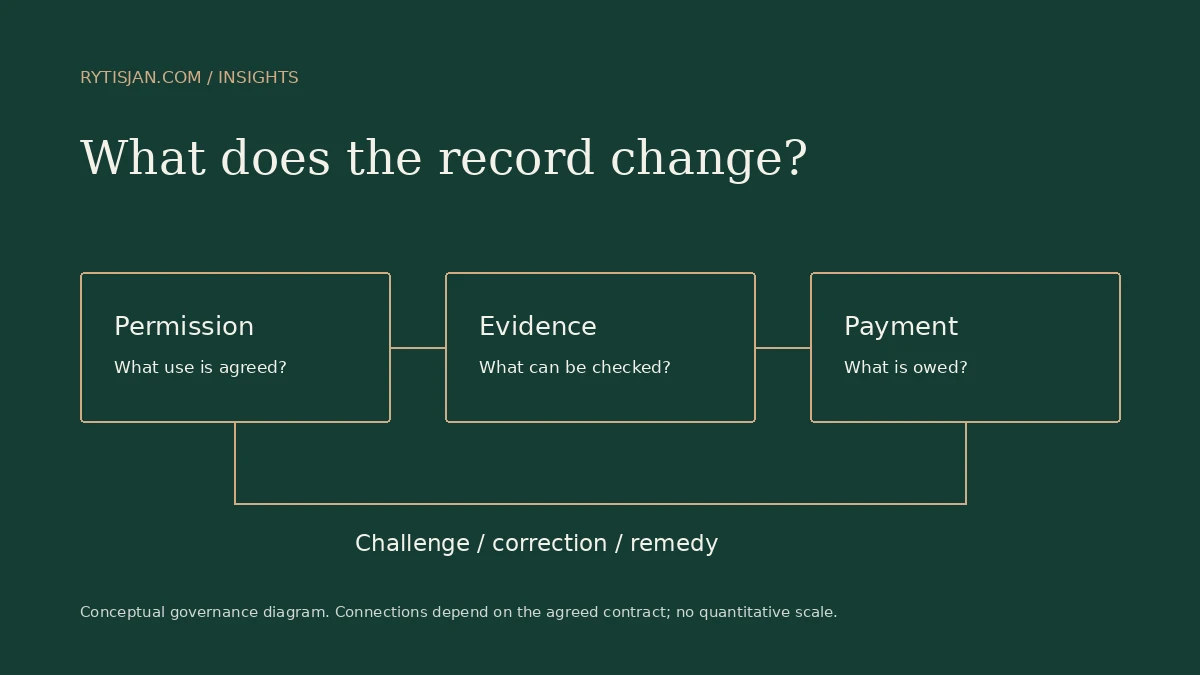
The record that changes the bargain
A label can tell a listener that a song was made with AI. An attribution report can suggest which recordings influenced it. Neither tells a songwriter whether the resulting payment is correct. The useful test of a creator-friendly music system is more demanding: can the person whose work entered the process trace the compensation decision, challenge an error and obtain a correction? Music executives should require that demonstration before treating technical attribution as evidence of a fair bargain.
This week’s announcements make that distinction concrete. In a November 4 press release, Sonilo and Musical AI described plans to measure contributions from licensed recordings and compositions to generated audio, supplying reports to licensing partners. The release presents an intended accounting mechanism. It provides no independent accuracy evaluation, disclosed payment formula or evidence of what an individual creator has received. [1]
Separately, The Next Web reported on November 5 that ElevenMusic users could publish directly to SoundCloud, with a label identifying the creation source. That is a distribution and disclosure change. The report does not establish how source creators are paid. These are separate arrangements, with no evidence that their accounting systems connect. [2]
The management temptation is to combine such developments into a reassuring story: licensed inputs, traceable outputs, informed listeners. The missing step is contractual. A record becomes economically consequential when an agreement specifies what it changes and someone can enforce the result. A technically elaborate report that has no bearing on a payment can still serve a useful purpose, but compensation should not be claimed as that purpose without showing the connection.
Consider a hypothetical license paying a fixed fee for access to a defined catalog. An attribution score might help assess the relationship at renewal. It would not necessarily alter the current amount due. Under a different hypothetical agreement, payments might depend on measured use. The same score would then influence who receives money. The technical question looks similar; the stakes of error differ sharply.
A licensing executive should therefore start with the bargain and work backwards. What event creates an obligation? Which record establishes that it occurred? Who receives the money, and under what agreement does it reach the originating creator? This is an inquiry into the proposed transaction, not a claim about the undisclosed terms of either announcement. The answer decides what measurement is worth buying.
Precision has a distributional cost
Output attribution has an intuitive attraction. If a system identifies contributions, participants might be paid in relation to them. But a numerical contribution is not self-explanatory. Similarity, influence and contractual entitlement are different concepts. Choosing how to connect them allocates economic power. A platform that selects the measure and controls the evidence holds a different position from a creator who sees only the final statement.
This is where the strongest objection to elaborate attribution deserves attention. A negotiated fixed payment or an agreed pool may compensate licensors without assigning a contribution to each output. Predictability can have value. So can avoiding the cost of reviewing vast numbers of small allocations. A system should not be judged inferior merely because it lacks a technologically impressive account of every generated song.
Indeed, a requirement for expensive measurement could favor large catalogs and well-resourced intermediaries. That is a possible mechanism, not a measured outcome from these announcements: where participating requires substantial technical integration or specialist disputes, smaller contributors face a different cost relative to their receipts. Management should test that burden before calling a detailed system more inclusive.
The case for attribution becomes stronger when its results affect a meaningful contractual choice and the measure survives scrutiny appropriate to that use. If an allocation changes compensation, participants need a way to understand and contest it. If it informs a renewal negotiation, the relevant test may concern consistency across the catalog. Validation should match the decision rather than decorate a general promise of transparency.
An audit trail need not expose confidential training data to every participant. A hypothetical arrangement could allow an independent reviewer to examine the relevant records, explain a disputed allocation and direct a correction under agreed procedures. Other arrangements could use simpler reconciliations. The important design choice is who can initiate scrutiny, who bears its cost and what happens when the objection is justified.
That also narrows the investment question. Access to a catalog may be strategically attractive, but access and a durable relationship are different assets. For diligence, an announced license establishes a starting point. The operational evidence lies in the obligations, records and remedies supporting it. None of this supplies a valuation or return forecast; it changes what an investor should ask management to demonstrate.
Make the promise demonstrable
Listener disclosure deserves its own test. Identifying the tool used to make a track can help describe its origin; it cannot, by itself, establish the full chain of permissions or a creator’s compensation. Nor does a source label settle whether listeners find it useful. The distribution report supplies no outcome study on comprehension or preference. A platform should measure those questions separately from the existence of the label. [2]
There is another boundary worth retaining. In its January 29, 2025 explanation of its copyrightability report, the US Copyright Office distinguished human expressive contributions from the mere provision of prompts, while affirming that assistance from AI does not automatically bar protection. That historical statement concerns copyrightability of outputs. It does not certify a particular model’s training permissions or resolve a contractual royalty calculation. [3]
For a music business commissioning an AI workflow, this means that a permission record, a contribution estimate and an account of human authorship answer different questions. Treating them as interchangeable leaves gaps even when each document is accurate. Responsibility needs to follow the decision: someone must own the permission inquiry, someone the payment reconciliation, and someone the correction when the available records disagree.
The most revealing approval exercise would be a worked example. Ask management to take one licensed work through the proposed arrangement and show which obligation arises, what evidence supports it and how a contested statement would be handled. Include an example in which the attribution is wrong. If the license uses a fixed fee, show how that fee is accounted for instead. The exercise tests the promise actually being made.
This is also a better way to assess access for new creators. Lower production and publishing barriers can be valuable even when a sophisticated attribution system is unnecessary. The objection to demanding records everywhere is legitimate: administration can consume resources that might otherwise support creative work. The response should be proportionality, with evidence requirements matched to the payment and permission claims, rather than a universal technical standard.
Evidence could change the judgment. A simpler arrangement with credible reconciliation and workable creator remedies may be preferable to detailed output scoring. Conversely, validated contribution records tied to contested allocations could justify their expense. Public announcements alone cannot establish either result. The approval decision should turn on a demonstrated process and its cost, with uncertainty left visible.
Music companies can reasonably experiment with new creation tools while negotiating how their value is shared. The executive responsibility is to make that bargain intelligible to the people supplying the work and bearing errors. Before approving a claim that AI rewards creators, require a record that can change a payment or correct a wrong. That is the point at which transparency becomes accountable.
Sources & public records
- Sonilo and Musical AI · press release distributed by Record of the Day · Sonilo–Musical AI partnership announcement · 2026-11-04
- The Next Web · SoundCloud lets ElevenMusic users publish AI-made songs directly · 2026-11-05
- U.S. Copyright Office · Copyright Office Releases Part 2 of Artificial Intelligence Report · 2025-01-29
Related analysis