Game studios should test the quality of a sale
A checkout experiment can count a sale before support sees the dispute. Studios should test whether players understood the price and chose to pay.
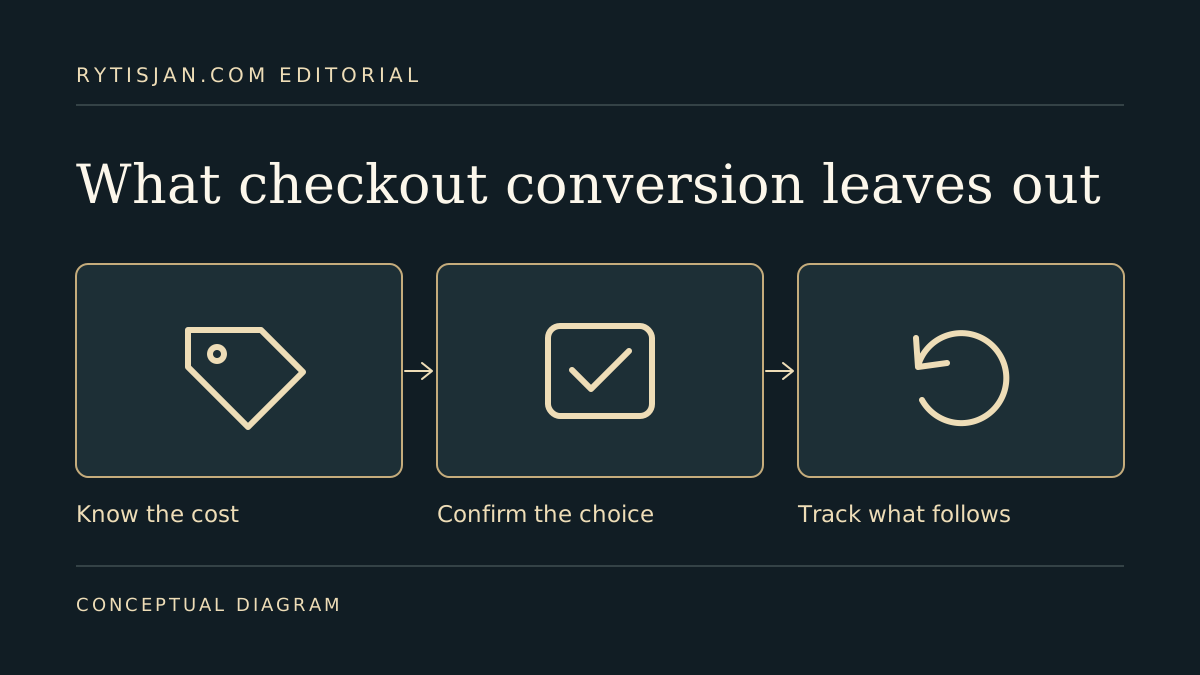
What the conversion number leaves out
A checkout test can declare a winner before the people who handle refunds have seen a single ticket. The purchase has already been attributed to the new design. The work of undoing it arrives later, often in another department. A game studio should expand a checkout change only after it can tell whether the extra purchases came from players who understood the offer and intended to buy it. Until then, the experiment has measured the response to a screen and left the quality of the sale unresolved.
The distinction matters in a business built around repeat visits. In its November 9 results, Take-Two reported fiscal second-quarter net bookings of $1.60 billion, down 18 percent year on year. Bookings from recurrent consumer spending fell 9 percent but accounted for 81 percent of the total. The category includes advertising as well as purchases such as add-on content and virtual currency. Its share can rise even as the dollars it contributes fall. For a board, the figures show the weight of continued engagement. They offer no diagnosis of the quality of any individual purchase or checkout. [1]
A studio can make a perfectly good sale with an in-game wallet. A player may prefer buying credit once to pulling out a card for each small purchase. But imagine an item priced in credits that can only be bought in bundles. A player who already has credit needs to understand the value being spent. A player whose balance falls short also needs to know what the smallest usable top-up will actually charge and how much credit it will leave behind. Showing one of those numbers can still leave the other decision obscure.
The immediate incentive inside the studio is to optimize the step with the cleanest data. Product teams can see a purchase event within minutes. They may have to ask a payments team for reversals and customer service for the reason a player disputed a charge. Parents who share a payment method with children face a different version of the same separation. The person deciding to spend, the person authorizing payment and the person who sees the statement may be different. A single conversion figure flattens those distinctions.
Where the cost turns up
The European Commission’s 2023 Consumer Conditions Survey asked about games that include purchases for virtual items. Among respondents who played such games, 23 percent reported that real-money prices for paid virtual items were missing at least some of the time. Two thirds said they rarely or never encountered problems with the sufficiency of information about paid virtual items. Ipsos collected these self-reports by telephone from adults in October 2022. The gaming figures describe the relevant subgroup of respondents. The responses point to uneven experiences and give a product team a reason to test its own interface. They cannot tell the team how many of its own sales would change under a clearer design. [2]
The EU Consumer Protection Cooperation Network’s principles, published in March 2025, put real-money price transparency and the treatment of children on the agenda for games using virtual currencies. The Commission also describes coordinated actions concerning suspected practices. That dialogue is a distinct step from a final finding. The practical question for a publisher is whether an ordinary player can reconstruct the amount charged from the screen they actually see in the game, with the account balance, device and currency they actually use. [3]
An older US example shows how far the consequences can extend beyond the transaction. In 2023, the Federal Trade Commission finalized an order requiring Epic Games to pay $245 million for consumer refunds to resolve allegations involving unwanted purchases. The order also addressed access to accounts when consumers disputed unauthorized charges. The settlement gives neither a general estimate of the cost of poor checkout design nor a forecast for other publishers. It shows why a dispute process belongs in the design review. A family trying to reverse a payment may also be trying to preserve access to what it has already bought. [4]
That is where responsibility should sit with the team that owns the offer. If one group gets credit for the sale and another absorbs every reversal, the experiment can pass its local target while making the business worse off. The same logic applies to a refund policy that keeps disputes out of the dashboard by making them difficult to submit. A low refund count is persuasive only when players can find the route to ask for one.
The rollout decision
The best objection is that adding friction can punish the people who already understand what they are buying. A well-designed wallet can make small purchases practical, let a parent set a budget in advance and spare regular players repeated payment prompts. Mandatory confirmation on every familiar transaction might irritate those players without improving consent. Start with the moments where the decision changes: adding fresh money, approving a payment on a shared account or switching to a bundle that leaves a balance. Keep the faster path where testing shows that people still understand the price and can decline.
Before expanding a design, give players in a usability test the screen they would see in the game and ask them to explain the charge, the remaining balance and how they would back out. Test authorized household settings separately. In a commercial pilot, compare otherwise similar groups over a full purchase cycle, including the period when disputes and refunds can arrive. Look at net receipts after refunds and chargebacks, the support work associated with them and whether people return and choose to buy again. Interpret each measure in context. A content release can lift repeat play, and a clearer refund route can initially surface problems that previously went unreported.
For an investor reviewing a live-service business, the evidence worth asking for is the comparison that survived those checks. If people understand both designs equally well and settled sales and repeat play hold up, there is a sound case for the simpler flow. If the apparent gain disappears when reversals and support work are included, management has a reason to withdraw it even if the original conversion chart still looks better. A studio should give the team that sees the purchase through to settlement a say in whether the checkout experiment wins.
Sources & public records
- Take-Two Interactive · Fiscal second-quarter 2027 results · 2026-11-09
- European Commission · Consumer Conditions Survey, 2023 edition, section 12 · 2023
- European Commission · Consumer Protection Cooperation actions and principles on in-game virtual currencies · 2025-03-21
- Federal Trade Commission · Final order in the Epic Games billing case · 2023-03-14
Related analysis