A sports-rights deal needs a place for the first-time viewer
A broadcaster can serve committed subscribers while the sport needs people who have not yet decided to pay. The rights agreement should make room for both.
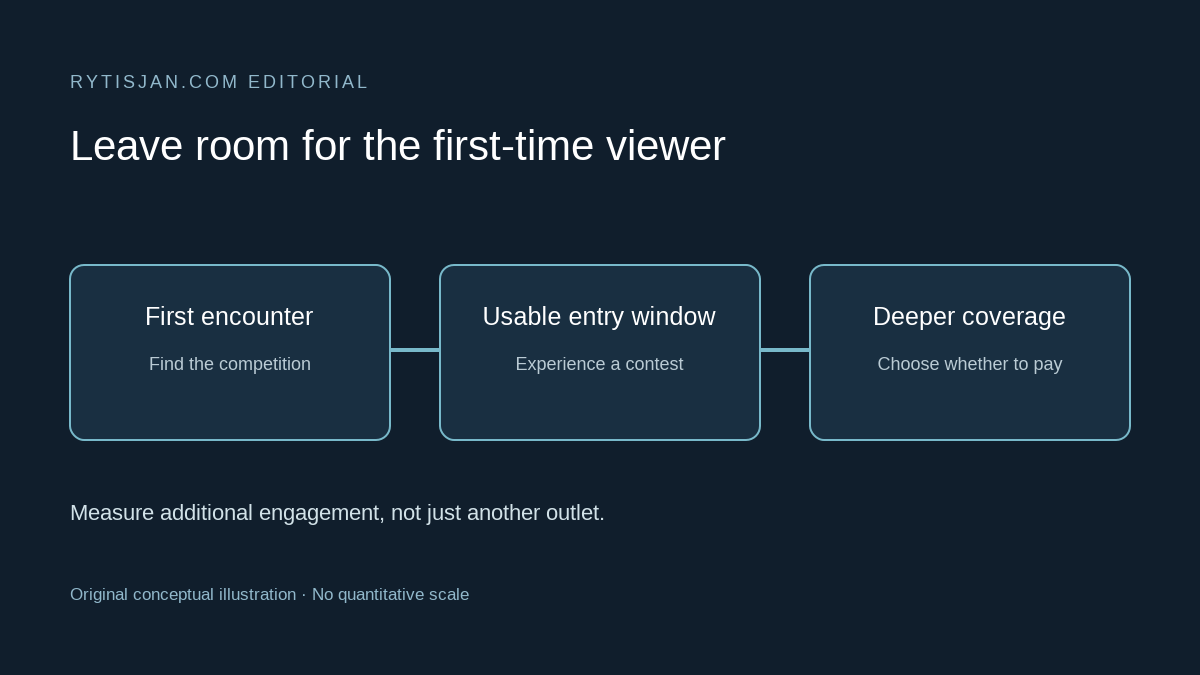
The viewer outside the bundle
A sport can sell exclusive coverage to a capable broadcaster and still leave its next audience outside the agreement. The committed fan knows what to buy. Someone encountering the competition for the first time may need to see a meaningful contest before deciding it is worth following. Rights holders should negotiate a usable entry window alongside exclusivity, even where preserving that window reduces the immediate guarantee. The case depends on whether it reaches additional viewers, not on an assumption that free television is inherently better.
MotoGP’s November 12 announcement with ESPN makes the distinction tangible. The agreement covers the 2027 and 2028 seasons. Its stated US arrangement allows coverage live or on same-day delay; Latin American coverage includes Disney+ Plan Premium. It also permits sublicensing selected events to free-to-air broadcasters in Argentina and Brazil. These are announced arrangements, not evidence that a sublicense has been signed or that a new audience has arrived. [1]
The commercial importance lies in the permission. A local broadcaster cannot offer an event merely because both it and the rights holder want more people to watch. The contract must leave that route available, with terms that make it worth using. A permission to sublicense creates an option; it does not establish the price, the broadcaster’s willingness or a useful position in its schedule. The announcement does not disclose those conditions or the rights fee. [1]
Consider the choice from the perspective of a hypothetical promoter negotiating its next agreement. A bidder offers a larger guarantee for control of every live event. Another accepts a recurring open-access window but offers less money. The second offer deserves consideration only if that window does work the exclusive partner would otherwise leave undone. The promoter is buying an opportunity to develop demand, and paying through foregone rights income. That cost should be visible rather than described as a costless commitment to reach.
This is also a distribution decision for households. Availability on a large platform and accessibility to someone without the relevant package are different facts. Neither tells us whether a person can discover the event, understand when it starts or watch enough to become interested. A rights holder pursuing new fans should care about that experience because it precedes the purchase on which a subscription strategy depends. It should not claim a social benefit merely because another outlet carries the pictures.
A window needs a place in the schedule
The NHL’s German arrangement supplies a more specific comparison. Bertelsmann’s November 11 account describes Nitro carrying Sky Sport’s coverage of all eleven Monday Night Hockey games in the season during German prime time, starting November 30. The package also includes the Germany Global Series games. At this review those broadcasts remain scheduled, not observed outcomes. The structure joins selected free-to-air exposure to an existing paid offering rather than substituting one distribution model for the other. [2]
That choice gives an acquisition window a recognizable place in a viewer’s week. A succession of isolated events can require a fresh act of discovery each time. A recurring slot offers a route back. Whether people actually use it is an empirical question. The announced schedule establishes what the partners intend to make available; it cannot establish that casual viewers become habitual fans, that advertising improves or that subscribers remain unaffected.
The complementary paid service matters. Sky’s own viewing guide identifies the broader NHL offer through Sky and WOW and specifies the relevant sports subscription. It also confirms the selected Nitro broadcasts. An open window therefore need not promise the whole competition. It can offer a substantial experience while a paid partner serves people who want more. That is the proposed economic division of labour, not proof that the particular package produces incremental subscriptions. [3]
Scheduling also qualifies the comparison with MotoGP. Live access and a same-day delayed broadcast can serve different viewers. A delay may suit an inconvenient event time and offer a better television slot; it may also remove the shared uncertainty that makes a live contest attractive. The right choice depends on the audience being sought. A contract that counts any transmission as equivalent can satisfy a coverage obligation while leaving that audience with a less compelling product.
A hypothetical first-time viewer illustrates the problem. A social clip attracts her attention, but the next full event sits behind a package she does not yet value. A later free broadcast might solve the sampling problem if it is findable, substantial and well presented. A brief highlights programme might be enough for another viewer. These are alternative acquisition products. The rights holder should decide which experience it is purchasing rather than equate the nominal number of outlets with opportunity to participate.
Exclusivity still has a business case
The strongest objection is that a committed exclusive broadcaster can develop the audience more effectively. It has an incentive to promote the competition because it captures the resulting subscriptions and advertising. It can invest in presentation, consistent scheduling and explanations for newcomers. Splitting windows can weaken that incentive, confuse viewers about where to watch and leave the free broadcaster with little reason to advertise a programme that benefits its paid rival.
There is a second objection: some apparent new reach is existing demand taking a cheaper route. A fan who already subscribes may watch the free event without adding anything to the sport’s audience. A headline audience total cannot distinguish that movement from genuine discovery. If the rights holder accepts a lower guarantee and loses paying viewers without attracting additional engagement, the access provision has spent money without doing the work used to justify it.
Those objections narrow the case for reserving rights. A useful agreement gives the open window a defined role and makes the partners’ incentives compatible with it. The paid broadcaster might supply production while retaining the broader season, as the announced German structure illustrates. The promoter can negotiate responsibility for promotion and an intelligible route from the sample to the wider competition. Such provisions have a cost. They are worth negotiating where the missing audience is important enough to justify that cost.
The measurement should distinguish newcomers from redistribution without requiring intrusive tracking. Aggregated audience research can ask whether viewers previously followed the sport and whether they return, using a disclosed sampling method and appropriate consent. The commercial review should separately examine paid engagement and sponsor value. Compare similar events where possible, account for teams, scheduling and promotion, and leave causal uncertainty visible. More viewers during an especially attractive contest is not, by itself, evidence that the access window caused the increase.
Evidence can favour the exclusive offer. If an existing partner demonstrably brings in new viewers through affordable access and effective promotion, a separate window may duplicate its work. If the open audience consists largely of existing subscribers, or cannot find the next event, the case for reserving more rights weakens. Conversely, documented additional participation can justify accepting less guaranteed income. The appropriate response is to change the bargain in light of those findings, not to defend free coverage as an article of faith.
A league negotiating exclusivity is deciding who gets paid to develop its audience and which people can experience the product before paying. That responsibility cannot be delegated through a general promise of exposure. Preserve an entry window when it offers a credible route to people the main package does not reach; pay the exclusive partner more attention when it already performs that task. The consequential choice is how much present certainty to exchange for a specific, measurable opportunity to bring someone new into the sport.
Sources & public records
- ESPN Press Room · MotoGP and ESPN announce broadcast agreement · 2026-11-12
- Bertelsmann · RTL Deutschland and the NHL expand their partnership · 2026-11-11
- Sky Sport · NHL viewing guide and free-to-air windows
Related analysis