An acquisition budget cannot spend an accordion
Optional funding can be valuable. It becomes a problem when a buyer makes an unconditional promise to a seller before that option becomes spendable cash.
The budget needs a funding date
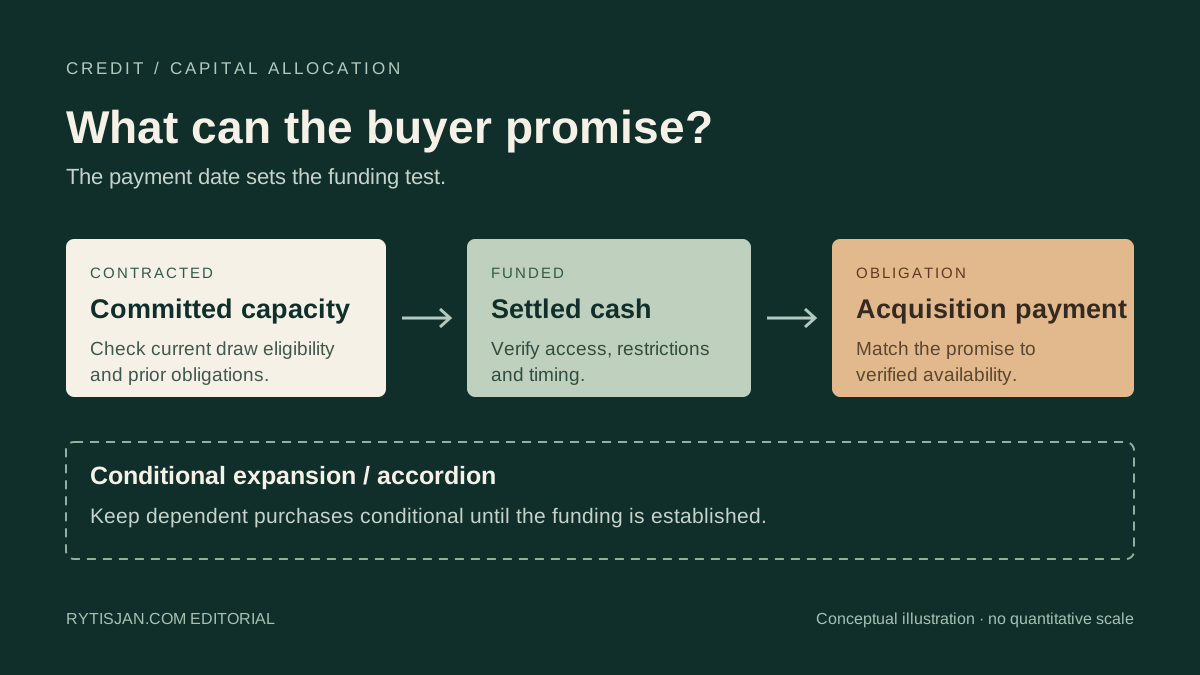
MusicBird’s new revolving facility has a distinction that belongs on the acquisition committee’s first page. Music Business Worldwide reported on November 19 that the headline maximum of $200 million comprises $70 million committed and a $130 million accordion. Those amounts describe different funding states. An entertainment buyer should make unconditional purchase promises against verified funding available at the payment date, and keep purchases dependent on expansion conditional. Paying for certainty can be rational even when the larger, optional facility looks more capital-efficient. [1]
The judgment is about who carries the interval between agreeing a price and paying it. A catalogue seller can stop negotiating with alternative buyers once a transaction is signed. A buyer can begin allocating staff and commissioning diligence. If the funding plan still depends on obtaining another commitment, somebody has accepted a risk that the facility headline does not describe. The acquisition committee should decide who bears it deliberately, rather than let a financing label decide by default.
The available MusicBird report names Truist and Fifth Third in the financing and describes investment in music rights as its purpose. It does not disclose the executed accordion conditions, borrowing-base rules, pricing, maturity, guarantees or actual borrowing. There is no basis here to call the entire maximum immediately drawable, or to infer how much the committed portion remains available after existing obligations. Nor does the missing public contract establish that the borrower has a funding problem. [1]
That evidential boundary makes the case useful. A board that knows the private terms can reach a firmer conclusion than an outside reader. It should reconcile the amount legally committed with the amount eligible to be drawn, subtract obligations already using that capacity, and align the result with the purchase timetable. A commitment is stronger evidence than an ambition to expand. It still needs to be tested against the conditions that govern access.
Consider a hypothetical catalogue buyer whose next purchase depends on increasing its revolver. If the seller accepts a financing condition and a realistic closing timetable, the buyer can preserve an option without pretending to have cash. If the purchase is unconditional, the same plan requires a committed alternative or a conscious decision to bear the shortfall risk. The asset and agreed price have not changed. The allocation of execution risk has, and that can change which offer a seller should prefer.
Pricing is progress; settlement is another event
Public bonds offer a different version of the timing question. On November 19, Gaming and Leisure Properties announced pricing of $600 million principal of senior unsecured notes issued by GLP Capital and GLP Financing II, guaranteed by GLPI. The coupon is 6.250%, the issue price 99.486% of par and maturity December 15, 2031. Its release described an expected December 1 settlement subject to closing conditions. As of this review, that is a priced offering, not evidence of completed settlement. [2]
The distinction is not an argument that pricing means little. It establishes far more than an untested intention to approach investors. It is an argument about what treasury can promise against it before cash arrives. The GLPI release also lists broad intended uses, including development, acquisitions and repayment of debt. That permission does not demonstrate that any particular purchase has been funded. A use-of-proceeds statement and a completed payment answer different questions. [2]
For a hypothetical buyer with a payment due before securities settle, the relevant comparison is between changing the purchase timetable and arranging a bridge. The bridge has its own availability conditions and cost; it is not created by the announcement of the permanent financing. The committee needs to see whether the temporary funding works if settlement is delayed, and whether it can survive without assuming the proposed takeout has already occurred. That is a transaction decision, rather than a forecast about the issuer.
Equity capacity needs its own treatment. SEGG’s November 19 SEC filing records termination that day of an equity line allowing up to $300 million of registered share purchases. Aggregate gross proceeds through termination were approximately $5.9 million, before fees and expenses. Purchases were priced at 94% of the lowest daily volume-weighted average during a period of up to five trading days, with a 4.99% beneficial ownership cap for the investor. This was share financing, not a loan balance. [3]
That filing does not explain why every unused part of the limit remained unused, and it cannot establish that the maximum could never have been accessed. It does show why a nominal purchase limit should not be presented as money raised. In an equity line, share issuance and its contractual constraints mediate access to cash. Existing shareholders bear a different economic consequence from lenders under a revolver. Treating these structures as interchangeable sources of available funding conceals the decision each requires. [3]
Buy certainty only where the transaction needs it
The strongest objection is that committed capacity can be wasteful. A buyer with uncertain acquisition opportunities may prefer to arrange an expansion mechanism rather than pay to reserve borrowing it never uses. Sellers can accept conditions, and an established financing relationship may reduce the practical difficulty of expanding a facility. Requiring every prospective acquisition to be prefunded could weaken an otherwise disciplined buyer by consuming liquidity or increasing financing costs before there is an asset worth buying.
That objection narrows the recommendation. The right commitment is the one that supports obligations the buyer has actually accepted. A discretionary pipeline and a signed unconditional purchase should not compete inside one undifferentiated budget. The former can legitimately depend on additional finance; the latter calls for stronger certainty or an explicit acceptance of execution risk. A treasury team should compare the cost of reserving funds with the commercial consequences of delay, including what the purchase contract actually requires if the buyer cannot pay.
A seller has a corresponding choice. A higher conditional offer can be attractive when the seller retains alternatives and the financing timetable is credible. A lower offer backed by verified funds can be preferable when completion matters more than the extra price. Creators transferring catalogue rights should understand that tradeoff through their advisers. It is not evidence that either financing structure produces better stewardship of the music; funding certainty and treatment of the rights after sale require separate scrutiny.
Evidence can overturn a conservative reading of expansion capacity. Executed incremental commitments, satisfied draw conditions and a funded backstop can make a previously optional amount suitable for a binding purchase. A seller’s matched financing condition can also remove the need to reserve all the money in advance. Conversely, an undrawn commitment constrained by eligibility or another obligation may support less acquisition spending than its nominal size suggests. The committee needs the contract and current availability record, not an assumption that every facility works the same way.
The practical judgment is to make certainty a priced part of the acquisition decision. Reserve committed funding where failure to close would impose an unacceptable obligation, and preserve conditionality where optional capital is the better bargain. Ask the finance team to show what becomes spendable, under whose control and by which payment date. An acquisition budget earns approval when it can meet the promises attached to the purchase, not when its financing announcement carries the largest number.
Sources & public records
- Music Business Worldwide · MusicBird revolving credit facility: committed and accordion portions · 2026-11-19
- Gaming and Leisure Properties · Pricing of senior notes due 2031 · 2026-11-19
- Sports Entertainment Gaming Global / SEC EDGAR · Form 8-K: termination of the Generating Alpha stock purchase agreement · 2026-11-19
Related analysis