A fair-work grant needs a remedy freelancers can use
Withdrawing a producer’s grant does not settle a contractor’s claim. Fair-work funding needs a route that freelancers can actually use.
A promise the contractor can use
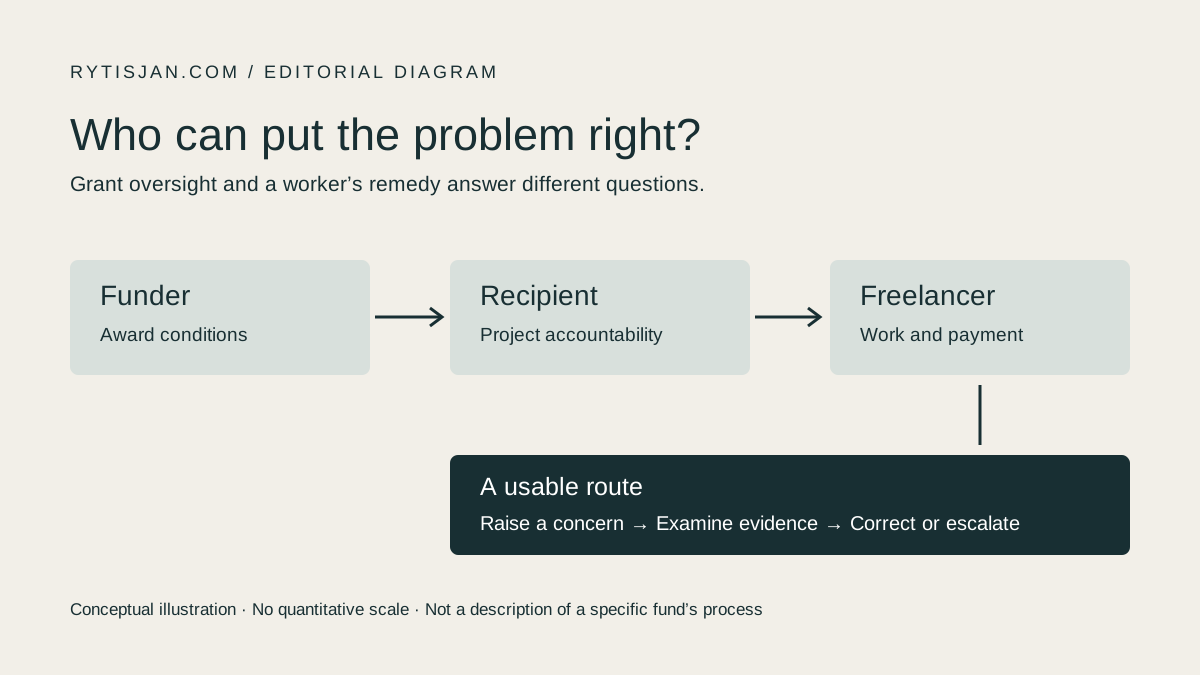
A film festival can satisfy a funder’s paperwork while a freelance programmer still has no practical way to challenge an unpaid invoice. The missing link is often between the organisation that receives the grant and the person who supplies the work. Public creative funders should judge a fair-work condition by whether a contractor can invoke it and obtain a proportionate response. Reclaiming an award from a producer may protect a funding programme’s integrity. It does not, by itself, settle the worker’s claim. A useful condition needs to explain how the two processes connect.
This is a timely implementation question, rather than a claim that a new system has already failed. Newcastle University’s November 11 account of the Creative PEC job-quality report described a shared good-and-fair-work commitment by major cultural funders, including the BFI and Creative Scotland. The report itself says shared funding conditions still need to be finalised. A statement creates a common starting point; its publication does not establish a uniform remedy across the participating bodies. [1] [2]
Existing practice offers something more concrete to examine. Screen Scotland’s Film Festival and Screening Programme Fund asks applicants to explain how fair work reaches freelancers and how their complaints would be handled. It also requires hourly or daily rates in the budget. These provisions place the contractor inside the application rather than leaving fair work as an employee-only concern. They are requirements for that programme, not proof that every funded organisation handles a dispute well. [3]
The gap matters because access to a complaints process cannot be assumed. The STUC’s historical survey received 805 responses from creative-industry workers between March 23 and April 22, 2025. Its summary reports that 73% rarely or never had a clear, accessible complaints and appeals process when doing freelance work. This was a respondent survey, largely of freelancers and people combining freelance and employed work, not a census of Scotland’s creative economy. It supplies a reason to investigate access in a particular programme, not an estimate of that programme’s failure rate. [4]
Withdrawing funding is a different remedy
The BFI’s published National Lottery general conditions illustrate the funder’s side of the relationship. They provide for progress reporting and access to project records, and allow funding to be withheld or reclaimed in specified circumstances, including an unrectified breach of funding conditions. These are meaningful controls over the recipient. The published provisions do not themselves amount to a promise that the BFI will pay a contractor’s disputed invoice. Compliance with an award and settlement of a private claim remain different questions. [5]
Consider a hypothetical festival that commissions a programme essay through an external producer. The writer delivers, the producer disputes an extra round of changes, and the festival’s report records a completed publication. Before approving the award, the funder could ask the recipient to show how that writer would identify the responsible counterparty and raise a concern. If the recipient’s policy covers employees but gives no route to a supplier’s contractor, a statement that everybody is covered leaves the difficult case unresolved.
The first response need not be an investigation by the grant officer. A named person can establish whether the dispute concerns acceptance of work, the payment timetable or conduct. That distinction determines which records matter and who is able to correct the problem. The contractor needs to know what the process can decide, what it cannot decide and where an unresolved claim can go. A producer also needs an opportunity to explain its position. A complaint is evidence requiring examination, not a finding against the recipient.
There is a financing consequence even without a large headline sum. A freelancer who has completed the work may be carrying the delay between delivery and payment out of personal cash. A grant recipient may simultaneously be waiting for its next instalment. Neither fact establishes misconduct, but a funder that asks only whether the project was delivered can miss where the delay ended up. Payment schedules, acceptance records and agreed changes can show whether the award’s administration is compatible with the commitments the producer has made to its team.
Simply stopping the next payment can make that mismatch worse. In the hypothetical case, an indiscriminate freeze could leave other contractors waiting while doing little to resolve the original dispute. The appropriate response depends on the agreement and the evidence. It might begin with a correction plan and confirmation of payments already due, with stronger restrictions reserved for serious or repeated failures. Direct payment by a funder should never be assumed: it would need an authorised mechanism that respects the parties’ contracts and avoids paying the same obligation twice.
Make the route proportionate, then test it
The strongest objection is administrative cost. A small festival may have a volunteer board and no personnel department. Requiring it to run a separate tribunal for every disagreement could absorb resources needed to commission work at all. Funders may lack the expertise to adjudicate private contracts, and duplicating a union, mediation or existing complaints route can confuse the people it is meant to help. Those objections argue for a clear boundary and shared support, rather than treating a longer policy as evidence of better protection.
Where an existing route covers freelancers, is understandable and can secure a correction, the grant should recognise it. The recipient could give each contractor a short explanation identifying the first contact and the escalation route, including an alternative when the concern involves that first contact. Requirements for records and response times should reflect the award and the risk. A route for a missed payment can be simpler than one dealing with alleged harassment. Confidentiality should be explained honestly, including who needs information to investigate; anonymity cannot be promised where it cannot be maintained.
A funder can check usability before commissioning another layer of rules. Ask a sample of contractors, including people hired through delivery partners, to find the route and explain the next step. Then examine a permissioned sample of completed cases: whether concerns were acknowledged, which obligations were established, what action followed and whether the person received an intelligible answer. Keep allegations separate from upheld complaints. A higher complaint count can reflect better access, while a quiet inbox can conceal either good practice or a route nobody trusts.
The disconfirming result matters. If the existing process reaches subcontracted workers, resolves substantiated problems promptly and leaves producers able to deliver, additional administration has a weaker case. If it works for employees but repeatedly loses freelancers between organisations, the next award should address that boundary. Neither result can be read from the presence of a policy or the number of people who attended training. The evidence should concern the route and the outcome, with personal information restricted to what the review actually needs.
For a funding committee, the decision belongs before the award is signed. Require the recipient to identify who can act when its fair-work promise is challenged, and to explain what happens when the first response fails. Provide proportionate support where the organisation cannot yet do that. Reserve withdrawal for a justified funding decision, rather than presenting it as a substitute for remedy. A public grant earns its fair-work claim when the people doing the work can use the commitment, including after their part of the project has ended.
Sources & public records
- Newcastle University · Creative PEC job quality report launch · 2026-11-11
- Creative Industries Policy and Evidence Centre · Job quality in the creative industries, 2026
- Screen Scotland · Film Festival and Screening Programme Fund: Fair Work requirements
- Scottish Trades Union Congress · Freelance and Forgotten: survey report
- British Film Institute · National Lottery Funding: general conditions
Related analysis