Which game studio cash flows can support a loan?
A studio’s strongest sales quarter can still leave a gap between what it has earned and when it can pay. The financing should fit that gap.
When the store owes you money
A game can have a strong launch and leave its studio short of cash on the day payroll is due. That timing gap is a good candidate for debt if the studio can show who owes the money, when it will be paid and how much is left after other claims. Borrowing to finish an unproven game is a different proposition. For studio boards, the useful dividing line is whether the financing bridges a delay in collecting cash or depends on creating demand that has yet to materialize. The distinction should decide how much a studio borrows, when the money comes due and which rights it is willing to give up.
Remedy Entertainment’s November business review offers a clean illustration of the timing problem. The Finnish studio reported €39.6 million in third-quarter revenue and negative €0.1 million in operating cash flow. It attributed part of the cash-flow picture to when payments arrived, and said trade and other receivables rose on game sales for which payment was expected in later periods. These are company-wide, unaudited figures, not a measure of the cash earned by a single title. They show why a lender can learn more about the next repayment from the settlement schedule than from a strong sales headline. [1]
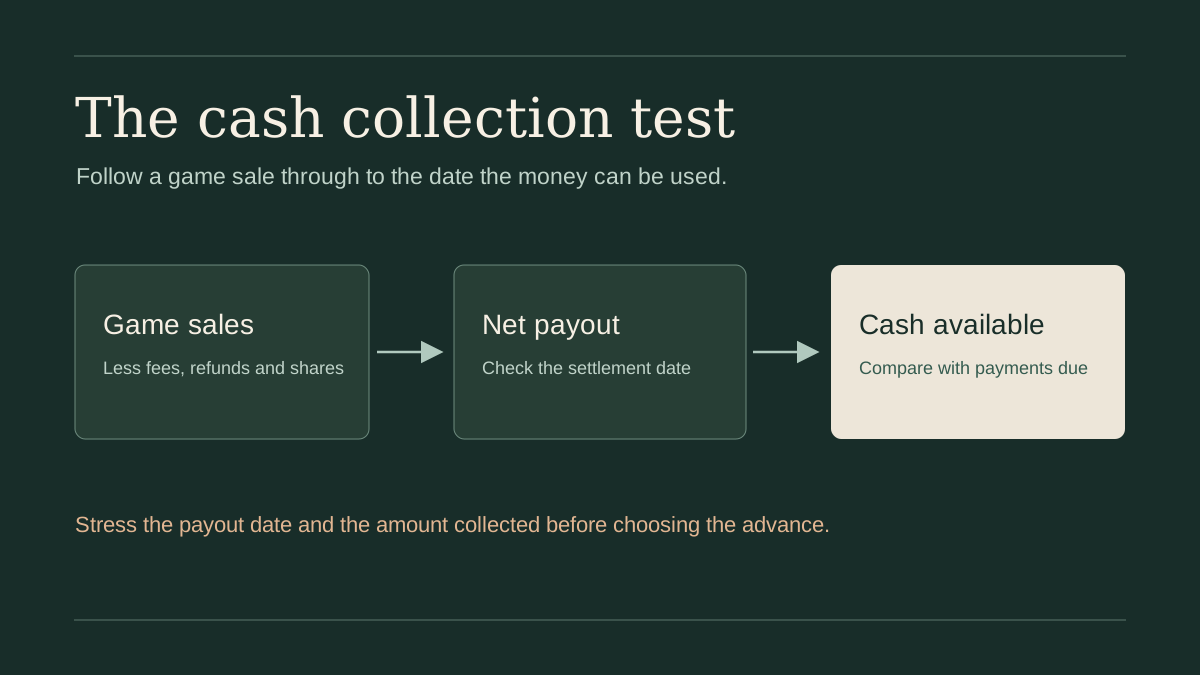
A receivables lender should start with what a storefront or publisher has agreed to remit. Refunds, platform charges and deductions for another party’s share can all separate sales from cash the studio can use. A signed milestone payment is helpful only to the extent that the acceptance test is clear, the counterparty can pay and the payment can legally be assigned or collected. A working-capital line can make sense against those receipts. Its limit should leave room for a distributor to pay late without forcing the finance team to defer wages or suspend work on a live game.
Marketing finance sits closer to the boundary. In October, Unity and PvX announced an arrangement that gives eligible studios access to user-acquisition financing based on the performance of groups of players acquired through campaigns. That is evidence from observed behavior, which is useful when a studio wants to buy more traffic for an existing game. The announcement did not disclose borrower-level rates, draw amounts, recourse or the repayment waterfall. A studio considering the offer still needs to know whether the financier is repaid from the financed campaign or can also claim receipts already supporting other games. [2]
When repayment depends on the game
Imagine a studio that can reconcile recent campaigns from the ad invoice through to the storefront payout. It can see when a typical group of players repays the acquisition cost in net receipts. That makes a limited draw for similar campaigns plausible. But the next spend could reach people who play less or cost more to acquire. The board should ask what happens if it stops buying ads after a weak campaign. If receipts from the players already acquired can service the advance on time, the financing is doing useful work. If the studio needs another campaign to cover the first, it is borrowing against a chain of future decisions.
For a game still in production, a development partner may be better placed to take that uncertainty. When Remedy and Annapurna announced their agreement in 2024, Annapurna agreed to finance half of the development budget for the game then called Control 2. The deal included screen adaptation rights for Control and Alan Wake. Remedy described recovery of the initial investments in proportion to the parties’ contributions, followed by a larger share of game sales for Remedy. The later business review identifies Annapurna’s share of Control Resonant revenue as a royalty expense. The disclosed arrangement can share a development bill while leaving Remedy with continuing obligations on game receipts and allocating screen opportunities to its partner. [3] [1]
Remedy also raised a separate €15 million unsecured convertible from a Tencent group company in October 2024. Its financial statements describe an 8% interest rate, a five-year term and a conversion option at €27.20 a share for principal and accrued interest. Interest capitalizes annually, easing the near-term cash burden while adding to the claim. At September 30, 2026, Remedy reported €16.1 million of liabilities related to that agreement. The carrying amount is an accounting figure. It does not measure new cash received or the amount required to settle on any particular date. A convertible gives a studio time and may provide cash for company-wide needs, while placing a claim on the company and giving the lender a route to equity under the agreed terms. [4] [1] [5]
Those deals solve different problems, and the public terms leave important limits. A project partner’s share of sales can be expensive if the game succeeds, especially when the studio also grants adaptation rights with value outside the game. A convertible can preserve more project economics through a successful launch, while shareholders still bear repayment or conversion risk. The board should compare what the studio retains in the same set of weak and strong outcomes. The comparison changes if a credible publisher guarantee covers the downside or a mature catalogue already produces sufficient collectible cash.
What belongs in the borrowing decision
There is a reasonable case for lending before launch. A diversified studio can sometimes service new debt from existing titles, even if the title it is building misses its target. A milestone contract with an experienced publisher can also shift some payment risk away from retail demand. In both cases the evidence is a repayment source that survives the weak launch. A concentrated catalogue, a payment that can be disputed or a guarantee that expires before delivery makes that case weaker. An independent test would look through the aggregate revenue figure to the contracts and actual settlements that make up the cash available on the relevant dates.
The financing decision should therefore start with a timetable a lending committee can verify. Put platform payouts after deductions beside wages, royalties, refunds and debt service. Push a payout back and cut the weakest campaign’s receipts. Ask which payments still clear using cash the studio can control. If the timetable fails, the remedy may be a smaller advance, longer tenor or a partner who is paid from the project’s success rather than from the studio’s next month of operating cash. A board that cannot identify where repayment comes from after a disappointing release should change the instrument before it signs away the cash the team needs to finish the game.
Sources & public records
- Remedy Entertainment · Business Review January–September 2026 · 2026-11-03
- Unity · Unity and PvX launch user acquisition financing partnership · 2026-10-27
- Remedy Entertainment via Cision · Stock exchange disclosure on Remedy and Annapurna’s cooperation agreement · 2024-08-29
- Remedy Entertainment · 2024 Board of Directors Report and Financial Statements
- Remedy Entertainment · Q3 2024 investor presentation
Related analysis