What studio investors buy when the publisher gets paid first
Remedy could take its Northlight tools from one project to another. Its publishing agreement gave Epic a claim on early sales. A studio investor needs to know which part of the business travels.
One engine, several games
Remedy’s Northlight tools went to work on Control, Crossfire and projects for Epic. The same agreement that let Remedy keep the games set out who would collect the sales proceeds first. Under the 2020 agreement, Epic would fund development and marketing and recoup those costs from sales before Remedy shared in net revenue. Remedy kept the intellectual property. For someone buying a stake in a studio, the engine and the games illustrate a difference worth pricing. Remedy could use its tools on the next project while its share of receipts on the Epic games depended on recoupment. [6]
That distinction is easy to lose in a funding announcement. Impact46 and Merak Capital co-led a $1.1 million round in racing studio NJD Games, according to the investor announcement and November 23 industry coverage. The reports identify the company that raised the money. They leave the security, valuation and commercial rights undisclosed. A founder weighing a similar offer needs to ask which choices will still belong to the studio when the production budget is spent. [1] [2]
Anorak offers a different, explicitly early-stage example. Play Ventures reports a USD 5 million pre-seed round co-led with Backed VC, with Supercell and MTG participating. PocketGamer.biz’s November 12 report describes a business developing playable formats and a creator platform. These are stated development ambitions, not demonstrated production savings or evidence of a successful platform. The disclosed round does not reveal the valuation, investor protections or allocation of rights. [3] [4]
The analytical attraction of a platform is that one investment in technology might support different experiences. That possibility deserves a company-level financing discussion, but calling software a platform does not establish it. An investor needs evidence that the company can reuse the underlying work, has permission to do so and retains a commercial route to customers. Otherwise, a broad corporate claim may be priced against an asset that exists only inside the first product.
This is also where the founder’s interests can diverge from a reassuring funding announcement. A project partner may pay the production team while shareholders remain exposed to central overhead and the interval before another commission. Conversely, a company investor can fund the experimentation that makes a project financeable at all. Comparing the two proposals means identifying which costs and choices each actually covers, rather than treating their headline amounts as competing offers for the same thing.
Ownership can survive a substantial claim on revenue
Project funding need not require surrendering the intellectual property. In its March 2020 publishing announcement, Epic described terms under which developers retained all IP and creative control, while Epic would cover up to 100% of development and publishing costs. Developers would receive at least 50% of profits after costs were recouped. Those historical published principles are a concrete alternative to selling company ownership, not evidence that every studio can obtain the same bargain today. [5]
Remedy’s August 2020 half-year review supplies a developer-side account of its actual arrangement. Under the agreement, Epic would cover development and marketing costs. Remedy retained its IP and creative freedom and was entitled to 50% of net revenue once game sales had repaid those costs. The same report identified Northlight tools being used across Control, Crossfire and the Epic projects. It therefore documented both a project-specific revenue claim and technology used beyond that project. Neither disclosure establishes a market valuation for those retained capabilities. [6]
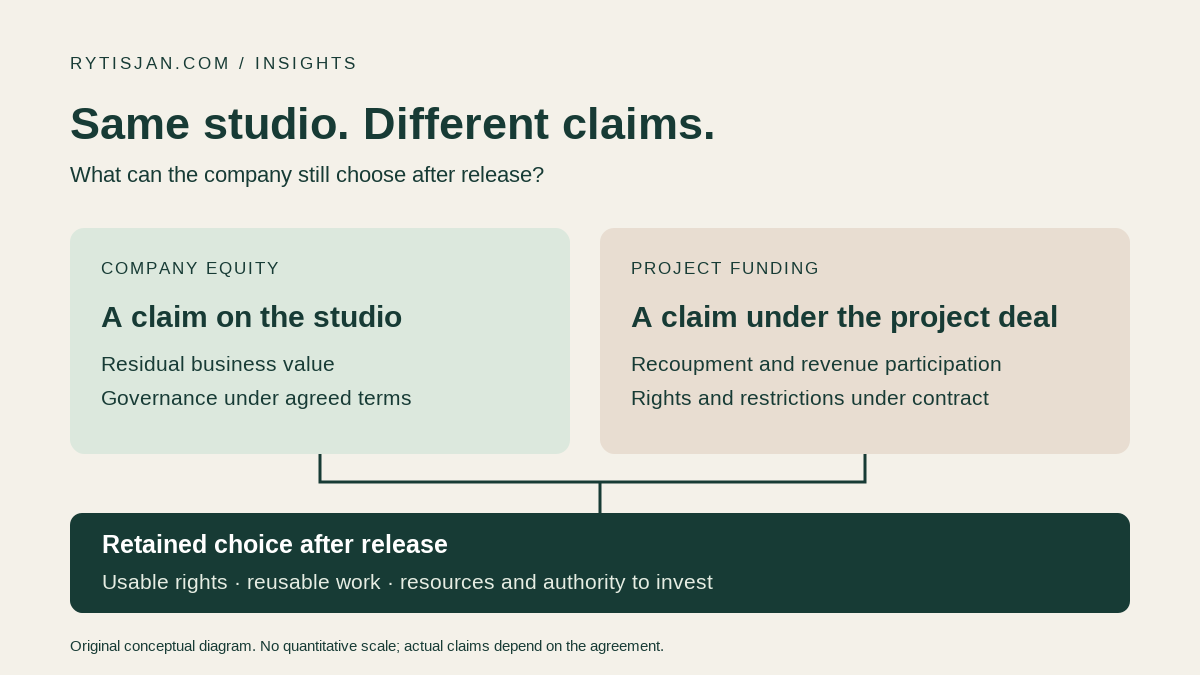
The economically useful comparison is between those two layers. A publisher’s recoupment claim can make development affordable while postponing the developer’s participation in sales receipts. The studio’s shareholders own the residual business, whose value still depends on what it can retain and exploit. Legal IP ownership is consequential, but it does not make receipts immediately available or establish the scope of sequel and other exploitation rights. Those require the actual agreement, not an inference from the announcement.
Consider a hypothetical studio that raises equity to build reusable production tools, then accepts publisher funding for a game using them. The combination can be coherent: equity bears the uncertain cost of developing the capability; project capital supports a defined production. But if the publishing agreement also restricts reuse or grants broad claims over later work, the equity investor’s original case has changed. The same capability cannot be treated as freely available to the studio in one financing presentation and contractually committed elsewhere in another.
The range of available structures is real, although individual terms remain private. DENMU’s November 5 final-close announcement says it uses project and slate financing alongside support for companies. It reported commitments exceeding its initial USD 50 million fund target. Those are commitments to a fund, not cash deployed into a particular developer. The release establishes that a project-oriented discussion is possible; it cannot establish a standard royalty rate, control package or cost advantage. [7]
For a founder, keeping project and corporate negotiations connected matters more than labeling one source of money non-dilutive. A project royalty can reach deeply into the successful game without changing the share register. Equity can preserve more project receipts while giving another party influence over the company. The relevant bargain is the resulting combination of cash claims and decision rights. Neither absence of dilution nor retention of IP is sufficient evidence of independence.
The strongest case for owning the studio
Sometimes the franchise itself is enough to justify buying into the studio. A team that knows its audience, controls its rights and can keep improving the same game need not manufacture unrelated projects to justify company ownership. Indeed, forcing a second title into the plan could divert the people and money that make the first worthwhile. The correct requirement is an economically usable choice after release, which may be continued investment in that franchise.
Equity can also absorb a form of uncertainty that a tightly specified production contract struggles to accommodate. Before the team knows what the game should become, milestones may reward completing the promised specification rather than finding a better experience. A founder can reasonably accept dilution to preserve room to change direction. That argument is strongest when the investor funds the search itself and the governance bargain permits it, rather than demanding project-style certainty alongside company-wide participation.
Nor does retained technology rescue every disappointed launch. Reuse may require extensive reworking; the relevant specialists may leave; a licence may limit the next application. For employees and creative leads, continuity depends partly on whether the financed capability has a usable purpose and funded work after delivery. Retaining rights creates an option, not a job guarantee. Evidence that reuse repeatedly costs more than replacing the work would weaken the case for paying extra for it.
Imagine a founder deciding between publisher funding and a smaller equity round for the same production. The publisher pays delivery costs but wants an exclusive option on the next game. The equity investor leaves that option with the company, while taking a continuing stake in future projects. Before comparing dilution, the founder should establish whether the studio can finance the interval between delivery and its first unrestricted receipts. If it can, preserving sequel rights may be worth the equity cost. If it cannot, the shortfall can force a second negotiation on worse terms before those rights become usable. This example describes two hypothetical offers; none of those terms is attributed to NJD or Anorak.
The decisive question for a venture committee is what it owns after the production it financed has been delivered and the project partner has taken its contractual share. A credible answer may be a franchise, reusable technology or a team with the resources and authority to choose its next work. If the answer is only an exhausted budget, a studio-shaped investment has been made in a game-shaped opportunity. The ownership claim should be negotiated accordingly.
Sources & public records
- Public investor update: Impact46 and Merak co-lead NJD Games round Return to citation
- Saudi Racing Studio NJD Games Raises $1.1M Return to citation
- Investor news: Anorak pre-seed round Return to citation
- Anorak raises $5m in pre-seed funding Return to citation
- Epic Games Publishing announces developer partnerships and principles Return to citation
- Half-year review January–June 2020: Epic terms and Northlight reuse Citation 1 · Citation 2
- DENMU Fund I final close and project/slate financing Return to citation
Updates & corrections
2026-11-24T21:04:38.718Z · Moved Remedy’s disclosed retained rights and cross-project tools ahead of the generic equity claim. Tightened the later investment decision.
2026-11-24T22:59:32.701Z · Opened on the contrast between Remedy’s reusable Northlight tools and Epic’s contractual right to recoup costs, then applied it to the limits of a disclosed studio raise. Clarified that the revenue share was a contractual entitlement after recoupment.